
Advertising Got ~30% More Expensive Since 2023.
The Fix Isn’t a Bigger Budget.
A field guide for in-house marketing teams.
If you run paid media in-house, you already feel this in your dashboards. The cost of buying attention has climbed steadily since 2023, and it isn’t slowing down in a way anyone should count on. Your CFO has noticed. Your peers are grumbling about it at conferences. And the instinct, when CPMs creep up, is to either throw more money at the problem or blame the platforms.
The increase is real, but most of it is happening for reasons that reward disciplined management and quietly punish autopilot. That distinction is the whole story, so let’s actually look at it.
What actually happened to costs
Google Search CPC has gone from about $4.22 in 2023 to $5.42 in the most recent benchmark data, roughly a 28% jump, and cost-per-click rose for 87% of industries in the last year alone. Meta is the same story from a more authoritative source: in its own SEC filings, Meta reported average price per ad up 10% in 2024 and another 9% in 2025. Third-party benchmarks put Meta CPMs up around 20% year over year, with some verticals absorbing 30%-plus.
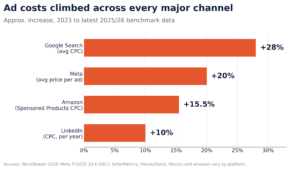
Figure 1 — Every major channel got more expensive. Metrics and windows vary by platform.
Amazon’s average CPC went from roughly $0.97 to $1.12 in a single year, about 15.5%. LinkedIn keeps drifting up 5–15% a year off an already high base. TikTok rose fast, then got volatile enough that no two sources agree on the current number (which tells you something about how thin some of this data is). The lone exception is X, where CPMs collapsed, but that’s an advertiser exodus over brand safety.
| Platform | Metric | 2023 | Latest | Change |
| Google Search | Avg CPC (US) | $4.22 | $5.42 | +28% |
| Meta (FB/IG) | Avg price per ad | — | — | ~+20% |
| Amazon | Sponsored Prod. CPC | ~$0.90 | $1.12 | +15–25% |
| CPC (per year) | — | $3.94 | ~5–15%/yr | |
| TikTok | CPM | — | — | Up, volatile |
| Microsoft | Avg CPC | — | ~$1.54 | ~flat (cheaper) |
| X (Twitter) | CPM | ~$7 peak | ~$0.86 | Down sharply |
Table 1 — Self-serve platform cost movement, 2023 to latest 2025/26 data.

Figure 2 — Google Search CPC has climbed every single year.
Even as CPCs spiked, Google’s conversion rates improved about 7% and cost-per-lead rose only around 5%, versus a 25% jump the year before. Translation: the raw “ads cost more” panic is real at the top of the funnel, but the down-funnel damage is a lot smaller if the account is managed well. The gap between that headline CPC and your actual cost per customer is exactly where the work happens.
Why it’s happening (and why it matters who’s driving)
Five things are pushing costs up, and four of them are structural. The biggest is boring: budget concentration. Everyone is crowding into the same “safe” pools (Search, Meta, TikTok, CTV). There is finite inventory and more bidders, so prices go up.
Second, signal loss. iOS App Tracking Transparency and the long cookie-deprecation saga stripped the conversion signal out of the auctions. When the algorithms can’t see outcomes clearly, they bid up to hit their targets. You are, in a very real sense, paying a premium for the platform’s uncertainty.
Third, black-box automation. Performance Max is now roughly 35% of all Google Ads spend, up from 22%, and it runs 20–25% higher CPCs than equivalent Search campaigns, partly because it bids against your own Search campaigns for the same queries. Google’s 2025 Smart Bidding update began optimizing for value over cost control, and many accounts saw CPCs jump 15–25% while maintaining the same target CPA without touching a thing. Many advertisers are paying to train an algorithm that doesn’t share its results.
Fourth, AI Overviews. Google’s AI summaries cut organic click-through by about a third, so traffic that used to be free now has to be bought. Fifth was the 2024 US election cycle, which vacuumed budget into CTV and social and spiked CPMs temporarily. That one was temporary, at least until the next election cycle.
Almost none of this is “the platforms are gouging you.” It’s that the platforms have built systems that default toward spending more, and they work beautifully if you let them run unsupervised. The increase is, to a meaningful degree, a management problem.
The challenge for in-house teams
The default settings on every major platform are tuned to extract budget, not to protect it. Advantage+ and Performance Max are genuinely good products. They’re also designed to make spending easy and restraint hard. Left on autopilot, they’ll happily cannibalize your cheapest branded traffic, bid you into your own auctions, and report it all back as a win.
Beating that requires two things most in-house teams are short on: deep, current knowledge of how each platform’s auction actually behaves this quarter (it changes constantly), and clean first-party measurement so you’re feeding the machine real signal instead of paying for its blindness. Not because in-house marketers aren’t good. Because staying current on this stuff is a full-time specialty, and it competes with the forty other things on your plate.
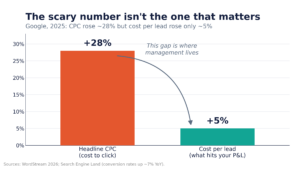
Figure 3 — A well-managed account absorbs most of the increase before it reaches your P&L.
The good news is that the levers that drive costs down are the same ones automation can’t do for you.
Three matter most:
- Measurement infrastructure. The single highest-leverage move is feeding the algorithms better data: server-side tracking, offline conversion imports, value-based bidding, real incrementality testing instead of last-click theater. Advertisers who strengthen their first-party data foundation report up to 25% lower CPA, not because they bid smarter but because the machine can finally see what a good customer looks like.
- Platform mechanics. A Quality Score of 10 pays roughly half the CPC of a Quality Score of 5 for the same keyword. That’s a 2x swing available through relevance, landing-page discipline, and account structure alone, before you touch a bid. Add PMax containment (brand exclusions, search-term controls) and bidding discipline anchored to CPA and ROAS rather than CPC, and you claw back a large share of the “increase” that never had to hit your cost-per-customer in the first place.
- Judgment. All of the above depends on someone knowing which lever to pull and when, which is not a junior skill and not a set-and-forget one.

Figure 4 — The cost advantage available through disciplined management, not bigger budgets.
Why small, senior, and technical is the right shape for this problem
This is where I’ll make the case for how we’re built at Modern Foundation, because it maps directly to the problem above.
We don’t staff accounts with juniors learning on your budget. Every account is run by operators with a decade-plus in the platforms, because the entire game right now is judgment about black-box systems that shift monthly, and you cannot outsource that to someone still learning what Quality Score is. When the auction dynamics change (and they change constantly), you want the person on your account to have already lived through three versions of it.
We’re technical first. The measurement plumbing (server-side tracking, first-party data pipelines, offline conversions, incrementality) is not an add-on we upsell. It’s the foundation, because everything else is downstream of whether the algorithms can see the truth. Get that right and the bidding takes care of most of itself. Get it wrong and no amount of creative saves you.
And we’re small on purpose. A senior-only, technically deep shop is the opposite of the agency model that got a bad name, where you’re sold by the partner and serviced by the intern. Fewer accounts, run by people who actually know the machinery, is not a limitation. For this specific problem, it’s the whole point. We’ve taken client CPAs down by double digits in environments where the platform CPCs were rising the entire time, not through a secret trick but by doing the unglamorous measurement and mechanics work that automation can’t do for you.
Ad costs are going to keep climbing. What’s up for debate is whether that increase lands on your cost-per-customer or gets absorbed before it ever gets there. That’s a management question, and it’s the one we’re built to answer.
Sources WordStream 2026 Google Ads Benchmarks; Meta Platforms FY2025 Annual Report (SEC); uProas 2025 Facebook Ad Benchmarks; SellerMetrics 2026 Amazon CPCs; HockeyStack 2025 LinkedIn Ads Benchmark Report; Statista X CPM timeline; Search Engine Land (rising Google Ads costs, conversion rates); Search Scientists (Smart Bidding and Performance Max).